top of page

Grace & Gigabytes Blog

Perspectives on leadership, learning, and technology for a time of rapid change

Ryan's book cover.jpg

Can you summarize yourself to smarts?


That seems to be the quiet bet underlying so much of our current relationship with AI. Last month, a friend told me, with a mix of pride and excitement, that he had stopped reading books and listening to podcasts. Instead, he takes the books he would have read and the conversations he would have listened to and runs them through ChatGPT, generating summaries, extracting core ideas and cutting out the rest. What he gains, in his view, is efficiency and clarity, the ability to get the value of a piece of content in a fraction of the time it would have taken to engage it directly. Spend less time on more content, he argues, and you'll get smarter, and more productive.


This instinct is not isolated. It is showing up in high school literature classrooms where students are increasingly turning to AI-generated summaries instead of reading Shakespeare or Twain, and it is present in the workplace where meeting recaps, call summaries, and condensed reading lists have become standard artifacts of daily work.


To be fair, we have always had versions of this. SparkNotes existed well before AI, and executive summaries have long been part of how we navigate complexity and abundance. Even the best teachers help students step back from a text to understand its structure and themes without requiring them to master every line.


But something important has shifted since the beginning of the AI boom. Even SparkNotes, for all its shortcuts, was still grounded in literacy. Its summaries were, generally speaking, accurate. But if you ask an LLM to summarize a specific chapter of Jane Austen, I'll bet you a bitcoin it makes a mistake. SparkNotes also published in sentences and carried a point of view, however simplified. It asked the reader to remain, at least in some small way, inside the act of reading. What we are seeing now is a move toward something more "frictionless," where the goal is not simply to clarify but to compress, not just to guide engagement, but to eliminate the need for engagement altogether. The summary is no longer a companion to the work of understanding an idea. It is becoming a substitute for it. And I wonder, if we eliminate the effort that leads to understanding, what else do we have?


I find myself less concerned about what this does to Shakespeare, who has endured centuries of reinterpretation and reduction, and more concerned about what it does to us, especially in the ordinary and unfinished parts of our lives where understanding is actually formed.


Life does not unfold in cleanly extracted insights, bullets, emojis, or em dashes. It takes shape in the hesitations and repetitions that fill real conversations, in the half-formed and run-on sentences that circle an idea before finally arriving at something true, and in the long, meandering explanations that could have been shorter but would have lost their meaning if they were. Some remark that a meeting could have been an email. But maybe the monotony of the meeting was just the thing needed to spark clarity?


When we listen to a podcast guest think out loud, changing their mind as they speak and fumbling for the right words, we are not simply collecting information. We are learning how to inhabit complexity, how to hold uncertainty, and how to think in real time. Why was President Obama an effective orator? Rhetoric, to be sure. But I would also suggest that his comfort expressing "umms" and hanging on to long pauses helped him to refine and polish his core ideas, shaping and sharing his vision simultaneously.


Awkward, grammatically incorrect communication is central to everyday interactions. When a colleague explains something imperfectly, or when a friend sends a message that is grammatically uneven but emotionally clear, we are reminded that communication is not a finished product but a shared process of meaning-making. These moments carry a kind of formative weight that is difficult to measure but essential to how we learn. When we sand down the "errs and ums" in the name of efficiency, we are not just removing excess. We are removing the conversational conditions under which understanding deepens. This really ought to give pause to those who work in ministry or faith formation. Where else can faith take root besides the fragmentation and messiness of lived experience?


There is a deeper cost here that is easy to overlook because it does not announce itself as a loss. When we outsource the middle of an experience, the wandering, the wrestling, and the repetition, when we erase the grammatical gaffes, we begin to lose something more subtle than information. We lose formation. Reading a book is not only about empathizing with the author’s conclusion but about undergoing the argument itself, feeling its tension, sitting with its ambiguity, and allowing it to work on us over time. Listening to a full conversation trains a kind of patience and attention that cannot be replicated by a summary. It teaches us to remain with ideas that do not resolve quickly and to resist the impulse to move immediately to closure.


Summaries, by design, collapse time. They promise arrival without journey and clarity without the discomfort of complexity. Over time, the "cheap grace" of a summary begins to shape us in ways that are disadvantageous. We become less practiced in sustained attention and less comfortable with ideas that require time to unfold. We grow accustomed to resolution and begin to lose our tolerance for ambiguity, not because we have consciously rejected it, but because we have slowly optimized for something else.


This is why I think of the AI summary as a kind of soft tyranny. There is nothing coercive about it. No one is forcing us to summarize our way through the world. It arrives as a gift, as a tool that saves time and reduces effort, and in many ways it delivers on that promise. But it also quietly narrows the range of experiences we are willing to engage. When something cannot be easily summarized, we are less inclined to give it our attention. When an idea takes time to develop, we are more likely to move past it. When a conversation wanders, we feel the pull to compress it into something cleaner and more efficient.


Over time, almost without noticing, we begin to prefer the summarized version of reality. We start to expect clarity without process and insight without effort, and we shape our habits accordingly. The danger is not that we will stop learning, but that we will begin to relate to learning itself in a thinner way, prioritizing extraction over experience, conclusion over formation, the answer over the question.


I do not think the answer is to reject summaries altogether. They have an important role to play in helping us navigate a world that is oversaturated with information. Summaries and redactions can orient us, clarify what matters, and make complex material more accessible. But they should not replace the full version. We still need long books and unedited conversations. We need amateurish podcasts with hesitant guests. We need the Director's Cut of Lord of the Rings. We still need messy drafts and uncertain thinking. We need spaces where ideas are not yet distilled and where understanding is still in the process of becoming.


The question is not whether AI can summarize the world for us, because it increasingly can. The question is whether we want to live in a world where everything meaningful has already been reduced to its most efficient form, or whether we are willing to remain in the parts of experience that resist summary. Those are often the places where understanding takes root, where insight is not delivered but discovered, and where we are shaped not just by what we learn but by how we come to learn it.
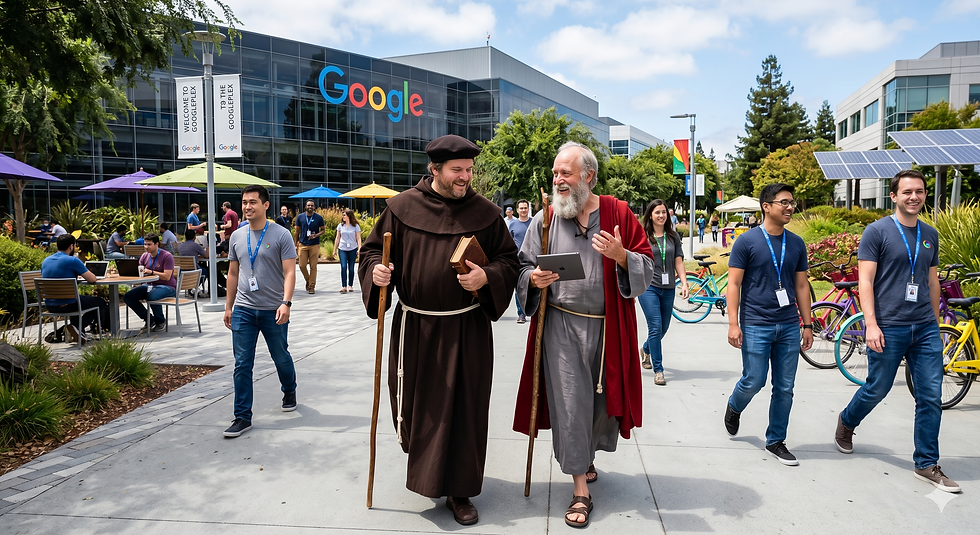


The anxiety beneath the AI boom is palpable. High performers (and high earners) in fields like software development, data analytics, and cyber-security are reading about rapid gains in AI capability, asking whether their job will be next. Some have responded with existential dread. Others have sought to control the situation by adding more technical skills, trying to chart a learning curve ahead of the LLMs. But what if the real risk in the AI boom isn’t falling behind? What if the real risk is becoming too replicable, too easy to re-create? 3.5 years into the AI explosion, it’s increasingly clear that AI doesn’t eliminate all, or even very many, jobs. Rather, AI isolates and exploits aspects of human labor that are easily “programmable.” Enter the Theologian as the AI-Proof professional, and Theology as a quintessentially irreplaceable skill.


Prior to 2022, career security, and affluence, almost necessitated the learning of scarce, complex technical skills like coding. In the age of AI, technical skills are increasingly automatable. See it for yourself. In under an hour, you can create an app of your choice via tools like Claude or Lovable. What once took years now takes seconds. When bots become technical, technical skills are no longer scarce. The rarified skillset of the AI age, the one that is truly impossible to automate, are the skills of judgment and meaning-making. While these skills might not be trained in Silicon Valley, they remain the bedrock of theology. 


As Cade Metz recently wrote in the New York Times, AI is exceptionally strong in narrow, highly structured domains. It possesses remarkable, yet “jagged” intelligence. It is surprisingly weak, however, in situations that are ambiguous, where the context shifts, where moral reasoning is necessary. Can ChatGPT solve complex math? Yes. Can it navigate real-world decisions that one might characterize as “judgment call?” Ask your chatbot to solve your next workplace dispute or standoff. I’ll wager you a bitcoin it won’t help one bit (or byte). 


Within this AI economy, jobs aren’t replaced wholesale. They are fragmented. Every role becomes a mix of automatable tasks, completed alongside a chatbot, and remarkably humanr responsibilities. The question is no longer “Will AI take my job,” but “In which parts of my work protected from AI’s jagged edges?” 


Thus, as AI handles structured tasks, economic, and vocational value, concentrates in areas with low feedback, high ambiguity, and true human consequence. Moreover, it becomes crucial to decide when AI is wrong, to interpret outputs critically, and to take accountability for the outcomes. AI can generate answers. We still have to choose which course to take. 

The time has come for the theologian. Theology, a discipline of wrestling with the sacred from a very human vantage point, involves tasks that no LLM can replicate. To theologize is to read complex and ancient texts across time and context, to accept that they have multiple meanings, and to construct a message or narrative that is resonant and relevant. 

To do the work of the theologian is to navigate ambiguous situations, responding with an articulation of what is faithful, reasonable, and conscientious. The chatbot follows scripted rules. The theologian forms a coherent view point that informs leadership decisions, ethical stances, and organizational culture. 


This is not to say that all programmers should become pastors or that all data scientists should study divinity. But it might be helpful for those fearing the jagged edges of AI to recognize how the discipline of theology, of interpreting meaning, is applicable more than ever. Presented with ambiguity, how might we account for the influence of tradition? How might we draw upon that which is authoritative? Where should we look for meaning, for purpose? We might not always bring up God when we bring up Google, but surely the theological task has newfound relevance for those in sales, marketing, product management, and many more “anthropological” fields. 


But were all programmers to become more pastoral, we might be in a better place societally. To think theologically is to consider what it means to be a minister. As Bonhoeffer would suggest, theology is inseparable from ministry. So our argument would be incomplete if we were to recommend that the AI-at-risk in our society only learn from the heady side of theology. Pastoral ministry involves attending to people navigating uncertainty, grief, and conflict. To be a pastor is to listen, to attend to difficulty in a way that is relational, rather than transactional. Who among us isn’t navigating uncertainty, grief, and conflict? Who among us wouldn’t appreciate the support of a non-transactional, non-anxious trustworthy person? The tech manager may not preach on the Gospel. But the pastoral skillset is increasingly important to the managerial class. 


Theology alone is seldom a career path. I’m not encouraging a generation of AI-displaced workers to enroll at divinity school (though some should give that serious consideration). Instead, the practice of theology will become a force multiplier for technical skill. The question isn’t “Does theology get you hired?” It’s “What kind of judgment shows up once you are?”


My advice to the class about to graduate is to learn a technical skill. To learn to work alongside AI. But to take a critical look at what these tools do, and how they are forming us. And at the same time, to read great texts and engage great works of art that cultivate patience, focus, and empathy. To put oneself in situations where ambiguity is a given and the next step isn’t obvious. AI fluency and the human formation form a powerful pair for the road ahead. Tools, paired with telos, will AI-proof your career. 


The future of work will not be evenly automated. It will be uneven, unpredictable, and responsibility-heavy. That puts a premium on judgment, presence, and meaning-making. The safest careers are found where AI keeps coming up short.


Did you ever take a career aptitude test?


Although I can't recall ever taking one myself, aptitude tests are frequently shown in popular media. In cartoons, these tests effectively match characters with their perfect professions. In movies, they often directed the main character towards their ideal career. A particular example that comes to mind is the (now controversial) film The Blind Side. Following an aptitude test, the character of Michael Oher excels in areas related to "protective instincts," which sets him on the path to becoming an NFL left tackle.


Regardless of the accuracy of these evaluations, they rely on the belief that a career assessment can collect personal information and produce the perfect job match. This basic assumption (despite its imperfections) will soon extend beyond the Guidance Office and into other technologies like GenAI and chatbots. We are on the brink of witnessing a surge in algorithmic career counseling, on platforms including LinkedIn, Indeed, and ChatGPT. AI will offer direct career advice with minimal user input, becoming the go-to career coach of the digital age.


Algorithmic career counseling will take several forms. Want to know what jobs to apply to? No need to attend a job fair or to actively build your professional network. Enter your education experience, skills, and interests into ChatGPT. Want to know where you would rank among the top 1% of applicants? No need to research a company. Just upgrade to LinkedIn Premium and upload your resume. Want to know if you are earning less than you are worth? Don't waste your time suspiciously grumbling around the water cooler. Describe your job responsibilities on a chatbot and ask it to analyze market compensation trends. People will turn to AI to try to find work that is more engaging, lucrative, and even impactful.


One of the key advantages of AI-powered job boards is their ability to continuously scan the vast landscape of available positions, presenting users with a curated selection of opportunities that align with their career aspirations. Through complex algorithms, AI can match candidates with roles that not only match their qualifications but also offer the potential for growth and advancement, making the job search process more efficient and targeted.


The integration of AI technology in career guidance will profoundly influence our perception of our professions. The integration of AI in these job boards goes beyond simple job listings; it delves into the realm of resume analysis and generation, providing users with personalized insights and recommendations tailored to their skills and experiences.


I am particularly worried about the implications of AI on individuals' careers and sense of meaning. By presenting users with an idealized version of their professional lives, AI has the power to amplify a worker's feelings of dissatisfaction with their present situation. In providing users with a vast set of ever-present alternatives, AI will taunt us with the promise that "true purpose" can be found on the other side of a job search. This is likely to increase dissatisfaction and unease at work, hindering career advancement and leading to increased turnover rates. Ultimately, we might all experience a lasting sense of uneasiness and dissatisfaction with our chosen careers.


My hope, however naive it may be, is that this unease and anxiety will prompt a return to more intentional and traditional methods of career guidance and vocational exploration, which can be effectively facilitated by clergy, lay ministers, and church leaders.


Dissatisfaction and the return of discernment


This dissatisfaction will lead to accelerating rates of turnover.


Employees will switch between employers, positions, and fields more frequently and rapidly. As one disappointing opportunity follows another, workers will swiftly seek out new changes. The length of time an employee stays with a company will decrease. Loyalty from employers towards employees (if there is any remaining) will further diminish. Even traditionally stable, full-time positions will begin to resemble freelance work. In this culture of continual job change, it becomes increasingly probable that we’ll find ourselves spending more time in roles that are distant from our core values and natural talents.


Speed and turnover are the antithesis of vocational formation. Guided by AI career advice, the active pursuit of vocational fulfillment will only breed vocational emptiness. That's because the factors that algorithms use to match users to jobs (an employee's skillset, and employer's compensation package) don't correlate with an inner sense of satisfcation, fulfillment, or meaning. They stand in contrast to a faith-driven process of vocational discernment, where we work with a trusted mentor or leader to discover our core values, recognize our innate aptitudes, and to identify where these individual gifts can be of service to the neighbor. In such a faith-driven process, we recognize the possibility that God may in fact have a calling in store for all of us.


Vocational formation is a lengthy process of working out our calling. A calling is not where our skills align with the needs of a business who is willing to compensate us for our time and efforts. Such a view is an impediment towards finding a meaningful vocation. To quote Frederick Buechner, a calling is "where your deep gladness and the world's deep hunger meet." No matter how quickly AI advances, it's improbable that it will ever be able to contemplate such concepts of "deep gladness" and "deep hunger." While AI may excel at processing vast amounts of data and performing complex tasks, the ability to contemplate and engage with the nuanced complexities of human emotions and desires remains a distinctly human trait.


Today's faith leader (or even a faithful person in a secular mentorship role) should take on opportunities to accompany individuals throughout the discernment process. This might involve shared inquiry into core values, mapping those core values to gifts and abilities, and identifying specific experiences where those gifts and abilities meet the needs of the neighbor. It will most certainly be more expansive than a "jobs" conversation. Vocation is a much broader concept than any nine-to-five, extending to familial, social, and cultural structures. A Christian vocational advisor is not merely focused on one's work life but is someone who can take a comprehensive and holistic approach to our life journey. By intertwining faith, values, talents, and community needs, these advisors help individuals uncover a sense of purpose that extends beyond personal fulfillment to making a positive impact on the world around them.


For all of the talk in the church about "decline" and "secularism," there is something to be gained when we take up the work of faithful vocational counseling. There is growth to be realized in identifying the connection points between a person's innate gifts and the world's great needs, with clarifying that God calls all of us to serve. The role of a faith leader or a faithful mentor is to illuminate the path towards a vocation that is not just about what we do for a living but about who we are called to be in all aspects of our experience. It is a journey of self-discovery, alignment with core values, and a commitment to serving others in a way that reflects the essence of who God created us to be. This process of contemplation and action not only benefits the individual but also contributes to the collective wellbeing of the community, creating a positive ripple effect that extends far beyond the walls of the church. This is a process that no chatbot can ever displace.


DSC_0145.jpg
@ryanpanzer

Leadership developer for digital culture. Author of "Grace and Gigabytes" and "The Holy and the Hybrid," now available wherever books are sold.

bottom of page