


As I prepared to preach on the Ascension, I recently found myself contemplating time travel. As one does.
There’s a fascinating connection between time travel and theology. Somewhere beneath all of our stories about time travel is a deeply human longing to believe that love might somehow transcend time itself.
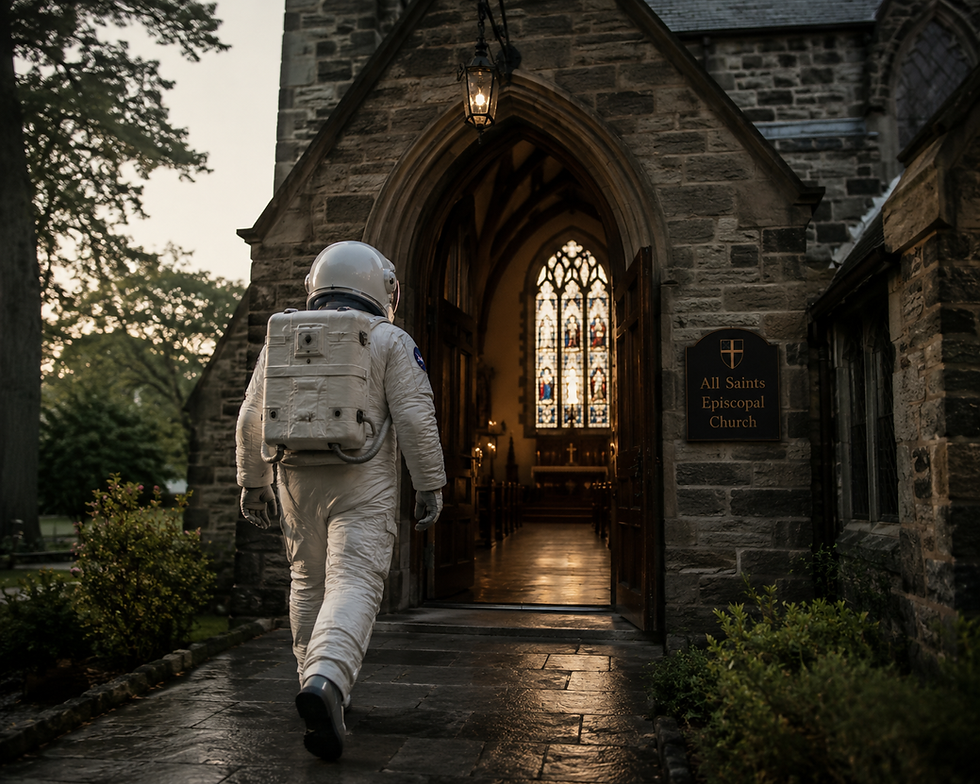
That longing shows up in everything from Back to the Future to Interstellar, where Christopher Nolan imagines time not simply as chronology, but as something fragile and permeable, something through which love still reaches. In one of the film’s most memorable scenes, Matthew McConaughey’s character falls into a black hole and discovers he can communicate across time by knocking books from a shelf in his daughter’s bedroom decades earlier. It is a strange scene, but also an oddly moving one. A father breaks through time to make love known.
Which, in its own strange way, is not entirely unlike John’s Gospel, where lectionary-following churches spend ample time each year after Easter.
John’s Gospel often feels less like reading a story and more like being swept up into a prayer already in progress. The sentences loop and spiral around themselves. Jesus speaks in these long bewildering passages filled with “I” and “you” and “mine” and “yours” until the whole thing begins to feel less like linear speech and more like language trying to stretch itself toward mystery.
In John 17, we find Jesus at the Last Supper offering what is often described as his “high priestly prayer.” He prays first for himself, then for the disciples seated around the table, and then, remarkably, for those who will come after them. For future disciples. For generations not yet born. For people somehow gathered into the life of God across centuries and cultures and history itself.
Somehow, Christ’s prayer reaches across time itself.
John’s Gospel insists upon one of Christianity’s most audacious claims: that eternity has entered ordinary human life. “The Word became flesh and lived among us,” John writes at the beginning of the Gospel, collapsing the distance between God and ordinary human life. God enters not abstract spirituality, but hunger and friendship and grief and betrayal and dinner tables and human vulnerability as it actually exists.
Which means Christianity is not fundamentally about escaping ordinary life in order to discover God somewhere else. It is about learning to recognize that God has already entered ordinary life fully.
That becomes especially important in a culture like ours, where so much of modern existence conditions us to believe that suffering, limitation, and uncertainty are interruptions to life rather than part of being human. We quietly absorb the assumption that with enough discipline, enough productivity, enough optimization, enough control over our habits and choices, we ought to be able to engineer lives relatively insulated from disappointment or grief or exhaustion. Which means that when suffering does arrive, as it inevitably does, we experience not only pain itself, but also the subtle suspicion that something must have gone terribly wrong.
The honesty of 1 Peter feels important here. “Do not be surprised at the fiery ordeal that is taking place among you,” the author writes, “as though something strange were happening to you.” Christianity does not romanticize suffering, but neither does it treat suffering as evidence of divine absence. In Christ, God has already entered fully into the vulnerability and fragility of human life, into sorrow and abandonment and physical suffering and death itself.
God does not observe human existence safely from a distance. God knows human life from the inside.
Which changes what trust means.
Christian trust is not naïve optimism or confidence that faithful people somehow avoid heartbreak. It is the conviction that even in the middle of ordinary human struggle, we are not abandoned. Jürgen Moltmann once wrote that “God weeps with us so that we may someday laugh with God,” and I suspect that line captures something essential about Christian hope. Resurrection is not denial. It is trust that suffering and despair do not ultimately have the final word.
This same collision between eternity and ordinary life appears again in the story of the Ascension in Acts. It is striking how little attention Acts gives to the mechanics of the event itself. Jesus is lifted up. A cloud takes him from their sight. The whole thing occupies barely a sentence. No explanation of heavenly geography. No detailed explanation at all. The real focus of the story turns out not to be Jesus ascending, but the disciples standing there staring upward while two figures ask them, “Why do you stand looking up toward heaven?”
The question matters because the meaning of the Ascension is not fundamentally upward, but outward.
The Ascension is not permission to disengage from the world while waiting for rescue from somewhere beyond it. As Douglas John Hall often argued, Christian faith is not escape from the world, but deeper engagement with the world in hope. Trusting that God has already entered ordinary human existence frees us to recognize holiness not beyond life, but within it: in classrooms and conference rooms, in hospital visits and difficult conversations, in caregiving and parenting and the quiet, mostly unnoticed work of loving neighbors well.
Which may also be why so much of genuine discipleship appears unimpressive by the standards of modern culture.
Most of the people who shaped my own faith were not celebrities or visionaries or extraordinary spiritual heroes. They were ordinary people who showed up consistently. Sunday school teachers. Parents. Mentors. Coaches. People who quietly carried the life of faith forward through patience, kindness, attention, and care.
And perhaps one of the defining spiritual anxieties of our age is the fear that ordinary lives are not meaningful enough. We fear our lives are too small, too unnoticed, too unremarkable to matter. We want to be astronauts traveling galaxies when most of life actually unfolds in ordinary acts of fidelity that rarely look impressive in the moment.
Which brings me back to Interstellar.
The movie’s true hero is arguably not Cooper, the astronaut traveling across space and time, but his daughter Murph, who remains on Earth doing the patient, difficult, unspectacular work set before her. She studies. She perseveres. She commits herself to solving a problem larger than herself without the glamour of cosmic adventure attached to it.
And maybe that is one of Christianity’s oldest and strangest claims: that eternity has already entered ordinary human life, which means God is not waiting for us somewhere beyond the world, beyond our work, beyond our grief, beyond parenting and caregiving and difficult conversations and the quiet responsibilities that fill ordinary days.
Christ is already here.
And the glory of God appears in our ordinary lives.

